The Industry Intelligence Platform is a fully autonomous local application designed to produce AI-enhanced periodic reports focused on the localization industry and leading technology trends, ready for online publishing. For details about the making of this project, interact with the tiles below.
Approach
A journey to discover progressively
Select a tile to open one chapter below.
The challenge
Making intelligence useful without losing the evidence
The project addresses a simple problem: industry signals exist, but they are dispersed, vary in importance and easily lose their provenance. The platform organises collection, qualification and delivery so readers can move faster without losing context.
Product framing
Defining needs, users, priorities and practical criteria for usefulness.
Solution design
Modular architecture, data contracts and an editorial reading experience.
Thoughtful automation
AI used where it accelerates work, with validation and traceability.
Quality & enablement
Testing, safeguards and documentation to keep the system maintainable.
Design principles
A product that is verifiable by design
The platform is designed to remain clear to operate, inspect and extend as its scope evolves.
Configurable
Configuration is separated from code. Sources and topics can be changed or added without rewriting the workflow, so the same reporting approach can be applied to another industry.
Traceable
Sources, design decisions and transformations remain connected to the result. Decisions are documented, then updated when functional testing reveals that the original specification should be improved.
Human-led
Automation supports judgement rather than hiding it. Human review remains responsible for relevance, publication and the interpretation of results.
Sustainable
Clear boundaries, data contracts and tests are defined early to limit technical debt and keep future changes understandable and safe.
Functional architecture
From signal to report
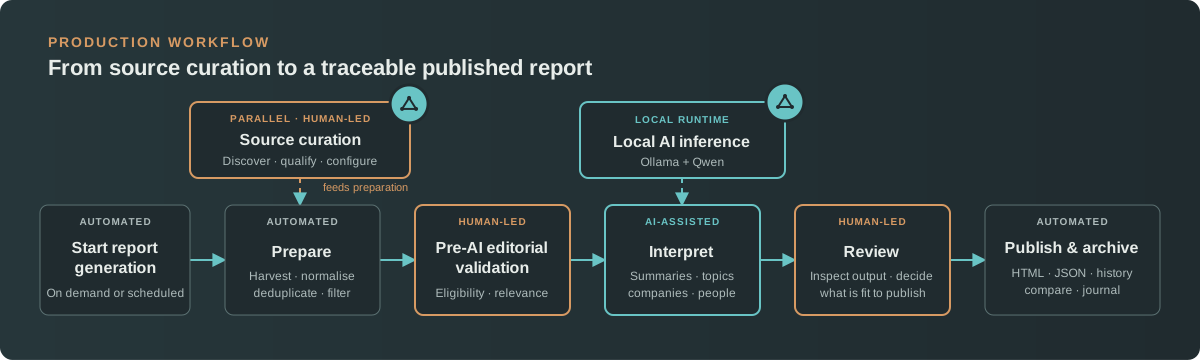
Human governance is the guiding principle throughout: people define the perimeter, validate content before and after AI processing, and remain accountable for publication decisions.
Each completed execution leaves publishable outputs and an internal traceability record.
The Pre-AI editorial validation may be fully automated with further AI in the loop in a next version, after the current observation period.
The platform development was assisted by frontier models through Codex, with higher-capability reasoning used for early architecture and implementation work, and lighter models used for refinement, recurring tests and maintenance.
For report processing, the requirement was different: qualify a resource-saving local model on modest hardware. After comparative tests, Qwen 3.5 9B provided the best balance for this use case. The goal was not to use AI everywhere, but to reserve probabilistic processing for the parts where it adds genuine value.
Operating principlePrefer deterministic Python automation for speed, cost, predictability and traceability. Use AI when interpretation is the problem to solve.
Editorial coverage
A curated perimeter, not a random feed
The source set covers specialist analysts and press, associations and think tanks, major LSPs, TMS and localization platforms, machine translation and language-AI providers, and emerging multilingual orchestration players.
Relevance
Sources must publish on Language AI, MT, LLMs, quality, automation, governance, agents, TMS, workflows or the sector’s economic evolution.
Recent activity
Official pages and recent publications are checked before a source is considered.
Respectful discovery
Collection follows website policies and robots guidance, with no bypass of access controls.
Editorial judgement
Automated results remain a screening layer; original sources remain available for verification.
Development approach
Specification first, increments under test
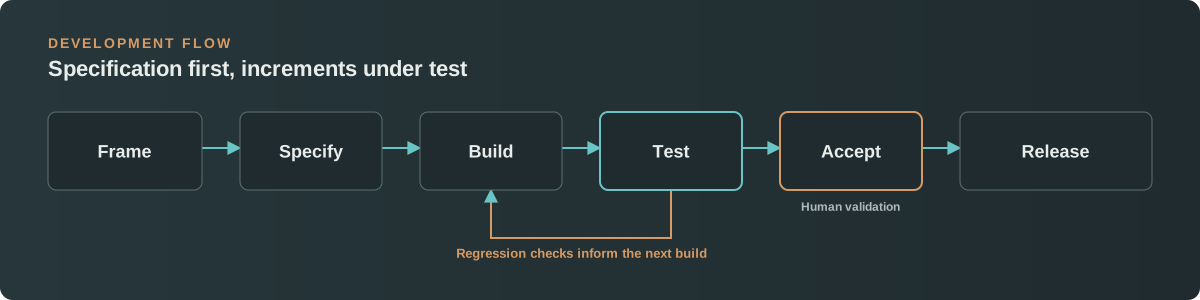
The work is documented through functional, architecture, data-model and version specifications. Development proceeds in staged blocks, with AI-assisted autotests and regression checks before each block is finalised, followed by human inspection and formal acceptance.
Nearly 300 automated regression tests support the current process, including module checks, global functional tests and human-in-the-loop arbitration.
Lessons learned
The preparation is part of the product
The most time-consuming work was not typing code. It was preparing accurate requirements, guardrails, architecture and data contracts, then iterating on source qualification, prompts, testing and quality control.
AI is a powerful assistant for research, coding, testing and documentation, but it is not the author. It can fail subtly, so human verification of sources, numbers, outputs and assumptions remains non-negotiable.
The quality of the result is governed primarily by the quality of the product definition, not by the speed of the coding loop.
Documentation managed in Obsidian and written in Markdown provides detailed traceability, while recording AI-assisted steps makes decisions easier to revisit. Yet maintaining a complete development-iteration log this way does not scale indefinitely, even for a solo project. As the product grows, professional work-management tools such as Jira remain the preferred standard for epics, user stories and version follow-up, while Obsidian remains the durable record of decisions and specifications.
!
AI-assisted development can accelerate coding and testing, but it also compresses the human work required to direct, verify and decide. Shorter feedback loops demand sustained attention, faster validation and more frequent context switching. Together with the tendency to keep consuming AI-generated information, this can create cognitive overload and AI-related mental fatigue. Product managers need to manage these pressures deliberately so that productivity gains do not come at the cost of sustainable work practices and work–life balance.
Roadmap
Build, observe, refine
Improve source curation and connector qualificationRefine local-model prompts and output arbitrationExplore sentiment, embeddings and comparative viewsExtend report delivery and website integrations
The platform remains an evolving independent product. Suggestions and constructive feedback are welcome.